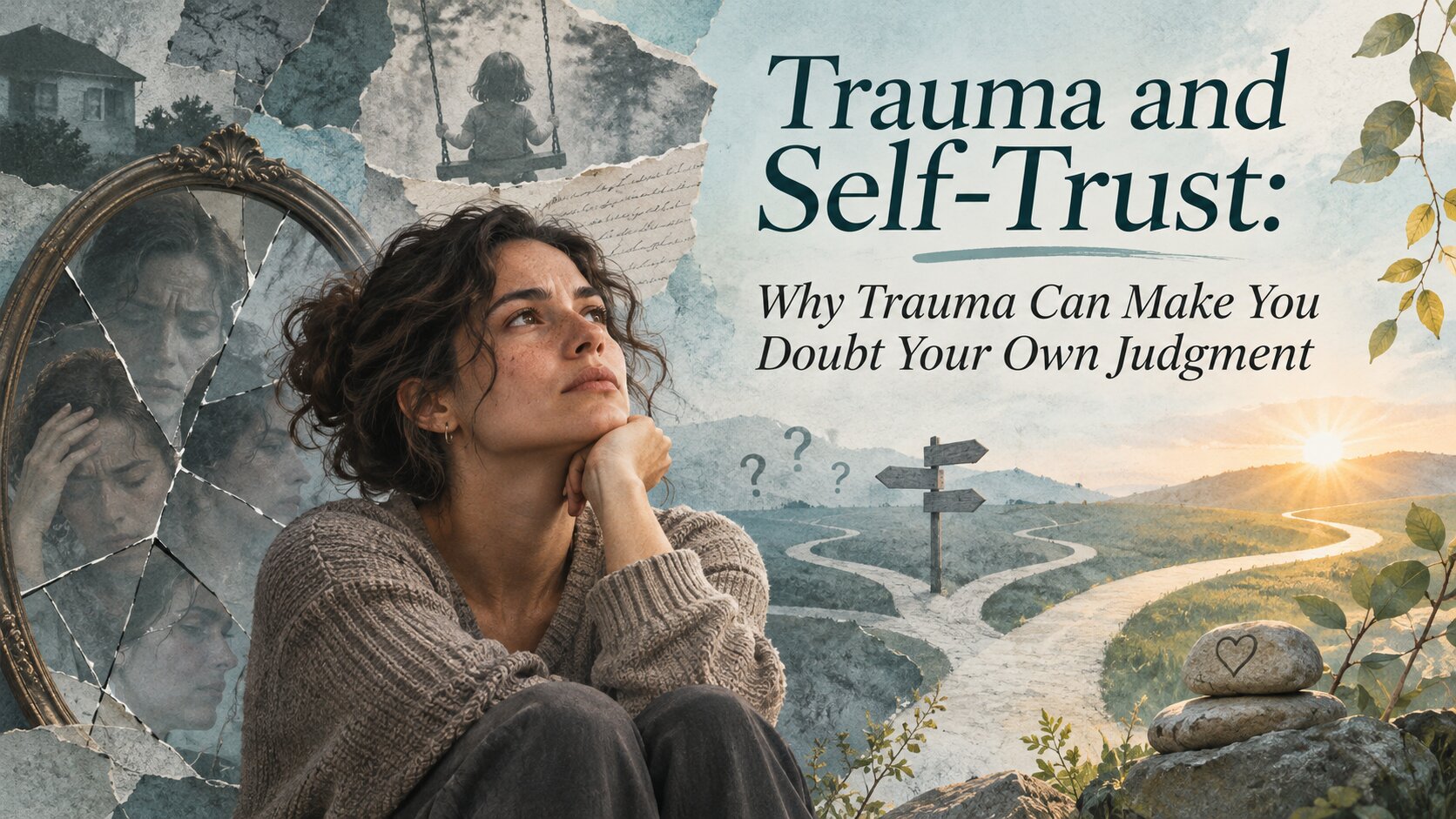
A person looks back on a painful experience and asks a difficult question: “Why did I not see it coming?” Another person remembers staying silent during danger and wonders why they did not speak. Someone leaves a harmful relationship but continues questioning every new decision. Even small choices may begin to feel difficult.
These reactions can reveal something trauma may damage beyond ordinary trust. A person may stop trusting themselves. They may doubt their judgment, memory, reactions, instincts, and ability to recognize danger. They may repeatedly ask other people what they should do because making decisions alone no longer feels safe.
This is where trauma and self-trust can become connected. Self-trust does not mean believing that every thought is correct. It does not mean having perfect instincts or never asking for advice. Healthy self-trust means believing you can notice information, make reasonable decisions, learn from mistakes, and respond when circumstances change.
Trauma can disturb that confidence. The difficult question becomes: How do you trust yourself again when your own judgment feels connected with something painful that happened?
What Does Self-Trust Mean?
Self-trust is confidence in your ability to understand situations and make decisions. It includes believing that your perceptions deserve attention. It also means recognizing that feelings can provide useful information without assuming every feeling is a fact.
Someone with healthy self-trust can believe they may not know everything but can still make a reasonable choice. They can ask another person for advice without believing that person automatically knows better. They can also change their mind when new information appears without treating the earlier decision as proof that they cannot be trusted.
Self-trust therefore includes uncertainty. Nobody has perfect judgment, and everyone makes mistakes. A person can trust themselves while knowing they sometimes get things wrong.
This distinction becomes important after trauma. People often judge their earlier decisions using information they only gained afterward.
How Trauma Can Damage Self-Trust
Trauma can challenge assumptions about how well someone understands people, situations, and danger. Imagine trusting someone who later harms you. Afterward, you may ask why you trusted them in the first place.
Imagine entering an ordinary situation that unexpectedly becomes dangerous. You may wonder why you failed to recognize the risk. Or imagine freezing instead of responding the way you always believed you would. You may begin doubting what you know about yourself.
These experiences can create a painful conclusion: “My judgment cannot be trusted.” That conclusion may feel logical because something terrible happened. However, an event turning out badly does not automatically prove the earlier decision was unreasonable.
Human beings make decisions without knowing the future. Trauma can make this simple fact very difficult to remember.
The article on Trauma and Meaning explains how trauma can damage trust in other people, the world, and oneself. Self-trust deserves deeper attention because it influences nearly every decision made afterward.
Why Didn’t I See It Coming?
This may be one of the most painful questions after trauma. Looking backward creates an illusion because once we know what happened, earlier warning signs may appear obvious.
A comment suddenly seems suspicious. A person’s behavior appears clearly dangerous. A past decision looks foolish. An earlier moment seems like the exact point when everything should have been understood.
But the person living through that earlier moment did not possess the knowledge they have now. They were making decisions using the information available at the time.
This difference matters because hindsight can remove uncertainty from memory. We begin seeing the past as though the outcome was always visible, even when it was not.
A person can miss a warning without having poor judgment. They can trust someone who deliberately deceives them without being foolish. They can enter a situation that appears safe and discover later that it was not.
Recognizing this does not erase regret. It helps place responsibility more accurately.
Trauma Can Turn Uncertainty Into Self-Blame
Uncertainty can be especially uncomfortable after something terrible happens. People naturally want explanations for why an event occurred and whether it could have been prevented.
Sometimes useful lessons can come from these questions. However, they can also become a search for personal fault.
Self-blame can offer a strange form of order. If the traumatic event happened because of one bad decision, perhaps the world can become predictable again. The person may believe they only need to avoid making that decision in the future.
That belief can feel safer than accepting that some harmful events cannot be perfectly predicted. The cost is severe because the person may protect themselves from uncertainty by deciding they were responsible.
They gain an explanation but lose trust in themselves.
Freezing Does Not Mean You Chose to Do Nothing
Self-trust can be especially damaged when someone remembers freezing during danger. People often imagine emergencies before they experience them and believe they know exactly how they would respond.
They may think they would fight back, run, shout, or leave immediately. Real responses can be very different.
Under extreme stress, behavior does not always follow a carefully planned decision. A person may freeze, become quiet, comply, or struggle to think clearly.
Afterward, they may judge themselves harshly and ask why they did nothing. These questions can turn an automatic or constrained response into evidence of personal failure.
That interpretation can damage self-trust far beyond the original event. A person may begin believing they cannot depend on themselves during difficulty.
A better question may be: What options actually felt available in that moment? The answer can look very different from what seems possible afterward.
Staying Does Not Always Mean Choosing
People sometimes blame themselves for remaining in harmful situations. This can be especially powerful after abusive or controlling relationships.
Looking back, leaving may seem obvious. But decisions are made inside real circumstances, not from the safe distance of hindsight.
Someone may have been afraid, financially dependent, threatened, isolated, manipulated, or uncertain about what was happening. They may also have hoped things would improve or lacked somewhere safe to go.
A decision made under pressure cannot always be understood as though every option was equally available. This does not mean people have no agency. It means agency exists inside circumstances.
Trauma theory becomes less useful when it asks only, “Why didn’t you leave?” It should also ask, “What made leaving difficult?”
That question protects self-trust because it replaces simple blame with a more accurate understanding of choice.
Betrayal Can Damage Trust in Yourself
When trauma involves betrayal, self-trust can become particularly difficult. Suppose someone trusted a partner, friend, family member, professional, or institution that later harmed them.
The obvious problem is losing trust in the other person. But another question may follow: “If I trusted them, what does that say about me?”
This can turn another person’s betrayal into an accusation against the self. The person may become suspicious of their ability to judge character and repeatedly review earlier conversations for clues they believe they missed.
Future relationships can then become difficult. Trusting another person requires some confidence that you can notice what is happening and respond if circumstances change.
If you no longer trust that ability, every relationship can seem dangerous.
Our article on Trauma and Psychoanalysis explores how betrayal and earlier relationships can affect later experiences of closeness. Self-trust adds another layer because before trusting another person, someone may need confidence that they can trust themselves within that relationship.
Manipulation Can Weaken Confidence in Your Own Perceptions
Some harmful relationships involve repeated manipulation. A person may be told they misunderstood what happened, remembered incorrectly, overreacted, imagined something, or caused the problem themselves.
Repeated experiences like these can weaken confidence in personal perception. Eventually, someone may begin checking their understanding with other people before believing themselves.
They may wonder whether a comment was actually rude, whether they are allowed to feel upset, or whether an event happened the way they remember it. Seeking another perspective can be healthy, but the problem begins when someone feels unable to take their own experience seriously unless another person confirms it.
Self-trust does not require rejecting outside feedback. It means your own perception gets a place in the conversation.
Trauma and Memory Can Complicate Self-Trust
Memory is another area where trauma can create doubt. A person may remember some details clearly while other parts remain uncertain.
They may remember an image but not the order of events. They may know something happened while struggling with the exact timing.
This can become frightening because the person may wonder whether uncertainty about one detail means they cannot trust anything they remember.
That conclusion goes too far.
Human memory is not a perfect recording system even without trauma. Memory can be incomplete, change over time, and contain errors. Trauma can also make some details difficult to recall.
Uncertainty about one part of a memory does not prove that every memory is false.
The article Trauma and Memory: Why the Past Can Feel Present explains how traumatic memories may affect present experience.
Self-trust requires a careful position between two extremes. We do not need to treat every memory as perfect, but we also do not need to treat every uncertainty as evidence that memory deserves no trust.
Second-Guessing Everyday Decisions
Loss of self-trust does not always remain connected with the traumatic event. It can spread into ordinary life.
A person may begin questioning which job to take, whether to send a message, how another person feels, or whether they made the correct purchase. They may spend long periods reviewing simple choices.
They decide, then reconsider. They ask one person for advice, feel better briefly, and then ask someone else.
The problem becomes less about the decision itself and more about confidence in the person making it. Even small decisions can feel risky when mistakes seem to prove something larger.
A disappointing restaurant choice is no longer just a disappointing meal. It can become evidence for the belief, “I cannot make good decisions.”
That interpretation gives ordinary mistakes far too much power.
Seeking Reassurance Can Feel Like Borrowing Someone Else’s Judgment
When self-trust becomes weak, other people’s certainty can feel comforting. A person may repeatedly ask friends, partners, relatives, therapists, or online communities what they should do.
Advice can be valuable, and nobody needs to make every decision alone. However, reassurance becomes something different when the person no longer believes their own judgment counts.
Someone else’s answer may bring temporary relief, but that relief may not last. The deeper question remains: Can I trust myself to make the decision?
Constant reassurance can therefore create a difficult cycle. The person feels uncertain, asks someone else, receives temporary confidence, and then learns again that confidence must come from outside.
Over time, this can weaken self-trust rather than rebuild it.
Self-Trust and Hypervigilance Are Not the Same
Someone who has lost self-trust may try to compensate by watching everything more closely. If they missed danger once, they may believe they must never miss another signal.
They study facial expressions, analyze messages, notice changes in tone, and monitor environments carefully. This can feel like becoming better at trusting instincts.
But hypervigilance and self-trust are different.
Hypervigilance says, “I must notice everything because missing one clue could be dangerous.” Self-trust says, “I can pay attention, make a reasonable judgment, and respond if new information appears.”
Our article on Trauma and Hypervigilance explains how constant monitoring can continue after danger has ended.
True self-trust does not require perfect detection. It includes confidence that you can adapt even when you did not predict everything.
Self-Trust Is Different From Control
Control can become another answer to damaged self-trust. Someone may believe that if they control everything, they will not need to trust their judgment under uncertainty.
They plan every detail, avoid unfamiliar situations, monitor other people, and create strict routines. The article on Trauma and Control explores how predictability can become connected with safety after trauma.
Self-trust offers a different kind of stability.
Control says, “Everything needs to go according to plan.” Self-trust says, “If the plan changes, I can still respond.”
That difference matters because control tries to remove uncertainty from life. Self-trust allows uncertainty to exist without turning it into helplessness.
Avoidance Can Protect Self-Trust and Weaken It
Avoidance may develop when someone doubts their ability to cope. A person may avoid dating because they no longer trust their judgment about partners.
They may avoid travel because they doubt their ability to handle problems. They may avoid conflict because they do not trust themselves to respond well under pressure.
Avoidance creates immediate protection because nothing can prove your judgment wrong if you never make the decision.
However, this also removes opportunities to discover something new. Perhaps you can choose carefully. Perhaps you can notice a problem earlier. Perhaps you can change your mind or leave.
The article Trauma and Avoidance explains how staying away from difficult reminders can gradually make life smaller.
Self-trust can shrink in a similar way when people never give themselves opportunities to make choices again.
Mistakes Do Not Prove Your Judgment Is Unsafe
One of the strongest barriers to self-trust is the demand for perfect judgment. A person may believe that if they trust themselves again, they must never make another serious mistake.
That standard is impossible.
No person can perfectly judge every situation. People misunderstand others, trust someone who later disappoints them, choose jobs they later dislike, and enter relationships that do not work.
Mistakes are part of decision-making.
Self-trust does not mean believing your judgment is flawless. It means believing that imperfection does not make your judgment worthless.
A person can make a mistake, learn from it, and make another decision. That process is not evidence of failed self-trust. It is part of how judgment develops.
You Can Change Your Mind and Still Trust Yourself
People sometimes believe that changing a decision proves the original decision was bad. It may prove something else.
Perhaps new information appeared.
Imagine meeting someone who initially seems trustworthy. Months later, their behavior changes or new facts become visible.
Ending the relationship does not necessarily mean the original decision to trust was foolish. It may mean your judgment changed appropriately when the evidence changed.
Self-trust is not loyalty to old decisions.
It includes the ability to revise them.
A person who trusts themselves can say, “I made that decision using what I knew then. I know more now, so I am choosing differently.”
This is very different from believing, “I should have known everything from the beginning.”
Feelings Are Information, Not Commands
Rebuilding self-trust can require a more balanced relationship with emotion. After trauma, someone may move between two extremes.
They may distrust every feeling because they believe trauma makes them overreact. Or they may treat every feeling as proof that something outside them must be dangerous.
Neither position is especially helpful.
Feelings contain information. Fear tells us that something has been perceived as threatening. Anger may signal a boundary, injustice, frustration, or loss of control. Discomfort may tell us something deserves attention.
But feelings also need context.
A trauma reminder can produce strong fear in a safe situation. Self-trust means taking the feeling seriously enough to examine it without automatically obeying it.
Instead of assuming, “I feel unsafe, so this person must be dangerous,” someone can ask, “What is making me feel unsafe, and what evidence do I have about the situation now?”
Trusting Yourself Does Not Mean Ignoring Evidence
Self-trust should never become the belief that instincts are always correct. Sometimes first impressions are wrong, anxiety changes interpretation, or another person notices information we missed.
Healthy self-trust can handle correction.
A person does not need to collapse because they were mistaken. They can recognize that they thought one thing, new evidence suggests another, and their judgment can change.
This is stronger than demanding certainty.
Self-trust therefore works best alongside fact-checking, reflection, and appropriate advice. You do not have to choose between trusting yourself and listening to others.
The goal is to avoid giving either source absolute authority.
Self-Trust and the Difference Between Caution and Fear
Trauma may make caution difficult to evaluate. Someone may wonder whether they are noticing a real warning sign or reacting because of their past.
There may not always be an immediate answer.
A useful approach is to slow the decision down when possible. Ask what actually happened, what assumptions are being made, what evidence supports the concern, and whether there is a pattern or only one unclear moment.
It can also help to ask whether the situation would look different after the emotional intensity decreases.
These questions do not require distrusting yourself.
They are ways of using judgment.
Self-trust can include investigation. In fact, the ability to examine your own assumptions without attacking yourself may be evidence of stronger self-trust.
Other People Can Help Without Becoming Your Decision-Makers
Supportive relationships can help restore confidence. A trusted friend may notice something you missed, while a therapist may help examine self-blaming beliefs. A family member may remind you that uncertainty is normal.
However, support works differently from surrendering decisions.
A helpful person does not need to tell you exactly what to do. Instead of saying, “You should leave,” they might ask what happens when you imagine staying. Instead of saying, “You are overreacting,” they might ask what about the situation feels familiar.
Good support helps someone think through the situation without making the final choice for them. It can return judgment to the person rather than replacing it.
This is especially important after trauma because having other people make every decision can repeat the feeling of losing agency.
Self-Trust Does Not Require Immediate Confidence
People sometimes imagine rebuilding self-trust as a sudden change. One day they doubt themselves, and the next day they become confident.
Real self-trust may grow through smaller experiences.
You make a decision and notice that you handled the result. You set a boundary and survive the discomfort. You recognize that someone is not treating you well and respond earlier than you once did.
You make a mistake and correct it without turning the mistake into a judgment about your entire character.
Each experience provides different evidence.
The message is not, “I will always get everything right.” It becomes, “I can deal with what happens next.”
That belief may be more durable than confidence based on perfect prediction.
Rebuilding Agency Without Demanding Certainty
Agency is closely connected with self-trust. It means recognizing that your actions can matter even when you do not control everything.
Trauma may create a strong wish for certainty. A person may want to know who is safe, what will happen, and whether every decision is correct before acting.
Agency asks for something different.
It means gathering available information, making a reasonable choice, noticing what changes, and asking for help when needed. It also means knowing that a decision can be revised, a harmful situation can be left, and mistakes can be learned from.
Agency does not require perfect safety.
It creates confidence in the ability to respond.
That may be closer to genuine self-trust than certainty ever could be.
Self-Trust Can Include Saying “I Don’t Know”
People sometimes confuse confidence with certainty. They assume a trustworthy person should always know what to do or decide immediately.
These expectations create unnecessary pressure.
Sometimes good judgment sounds like, “I don’t know yet.” It may also sound like, “I need more information,” “I want another opinion,” “I need time,” or “I changed my mind.”
These statements do not show weak self-trust.
They can show accurate judgment.
Self-trust includes respecting your own uncertainty rather than covering it with false confidence. You do not need to know everything to trust yourself.
You need enough confidence to keep thinking.
When Professional Support May Help
Many reactions after trauma decrease over time. People often recover through their own coping abilities, relationships, and support systems.
Professional help may be useful when self-doubt, anxiety, traumatic memories, avoidance, or related reactions continue interfering with relationships, work, decision-making, or daily life.
The goal should not simply be to make someone more confident.
Confidence without accuracy is not the aim.
A more useful goal is developing balanced beliefs about responsibility, safety, trust, and judgment. Trauma-focused approaches may also help people examine distorted self-blame and extreme beliefs that developed after the event.
The larger goal is not perfect judgment.
It is a more realistic relationship with your own judgment.
What Trauma Theory Still Needs to Ask About Self-Trust
Self-trust raises questions that deserve more development. One concerns digital life because people can now ask hundreds of strangers whether a decision is reasonable. They can search every symptom, message, relationship problem, and social interaction online.
Useful information can help, but when does information-seeking become an alternative to trusting your own judgment?
Another question concerns artificial intelligence. People can increasingly ask software what to write, choose, believe, or do. These tools may offer useful perspectives, but what happens when someone who already doubts themselves begins outsourcing more decisions?
A third question concerns manipulation. How should trauma theory understand self-trust when someone’s perceptions were repeatedly challenged by another person or institution?
There is also a deeper question: Does self-trust mean believing yourself, or believing that you can examine yourself without abandoning yourself?
The second possibility may be more useful.
Readers interested in self-trust, judgment, betrayal, or decision-making after trauma are welcome to begin that discussion in the comments. A thoughtful question may identify another part of trauma theory that deserves deeper attention.
Conclusion
Trauma can damage more than trust in the world or other people. It can damage trust in the person making the judgment.
Someone may ask why they did not recognize danger, why they froze, why they stayed, why they trusted someone, or why their memory feels uncertain. Those questions can gradually become a larger belief: “I cannot trust myself.”
But a painful outcome does not prove that every earlier decision was unreasonable. Human judgment is always made with incomplete information.
Self-trust does not mean believing that you will never make another mistake. It means understanding that mistakes, uncertainty, and changing your mind do not make you incapable of judgment.
You can notice feelings without treating every feeling as fact. You can seek advice without giving another person ownership of every decision. You can check evidence without assuming your own perspective has no value.
You can choose and later choose differently.
Most importantly, self-trust does not need to provide something no human judgment can provide: perfect prediction.
Trauma may leave someone asking, “How can I trust myself when I did not prevent what happened?”
A more useful answer may begin here:
You do not need to predict everything to trust yourself. You need to know that when life changes, you can notice, think, choose, respond, and choose again.


