Archives for : July2026

PTSD and Dissociation: Why Trauma Can Make the Mind Feel Divided

PTSD and dissociation are often connected. Many people with trauma feel fear, panic, or painful memories. Others feel numb, distant, or cut off from themselves. Some people feel both at different times.

This can be confusing.

A person may know something terrible happened. But they may also feel separated from the memory. They may remember parts of the event, but not all of it. They may feel calm when they expect to cry. Or they may suddenly feel fear without knowing why.

This is where dissociation becomes important.

Dissociation is one way the mind handles overwhelming experience. It can create distance from pain, fear, memory, or the body. In the moment of trauma, this distance may help a person survive. Later, it may make life feel divided.

What Is Dissociation?

Dissociation means separation.

In trauma, it usually means that parts of experience become disconnected. A person may feel separated from their emotions, body, memory, or sense of self.

This can happen in many ways. Some people feel as if they are watching life from outside themselves. Some feel as if the world is not real. Some feel emotionally numb. Others lose parts of memory around a traumatic event.

Dissociation can feel strange and frightening. But it often begins as a survival response.

When an experience is too painful to face directly, the mind may create distance from it. This distance may protect the person from full emotional impact. It may help them get through something unbearable.

Dissociation is not weakness. It is not laziness. It is not a lack of feeling. It is often the result of too much feeling, too much fear, or too much pain.

How PTSD and Dissociation Are Connected

PTSD stands for post-traumatic stress disorder. It can happen after a person experiences something frightening, violent, painful, or overwhelming.

PTSD is often linked with flashbacks, nightmares, avoidance, fear, and constant alertness. But PTSD can also involve numbness, emotional distance, and disconnection.

This is where dissociation enters the picture.

Some people with PTSD feel trapped in painful memories. Others feel cut off from those memories. Some move between both states. They may feel flooded one moment and numb the next.

The post Are PTSD and C-PTSD dissociative disorders? Does it matter? explores this question in more detail. It shows that PTSD and C-PTSD may involve dissociation, but dissociation is not the whole story.

That point matters.

Dissociation is often a defense against terror. The terror comes first. The mind creates distance because the experience feels too much to hold.

Why Trauma Can Make the Mind Feel Divided

Trauma can divide experience into parts.

One part of the person may know the event is over. Another part may still feel unsafe. One part may remember clearly. Another part may avoid remembering. One part may want connection. Another part may fear closeness.

This divided feeling can be painful.

A person may think, “Why do I feel this way?” They may know they are safe, but their body may still feel danger. They may want to trust someone, but feel fear inside. They may want to speak, but words may not come.

Trauma theory helps explain this.

Trauma can be too overwhelming to understand while it is happening. The mind may not turn the experience into a clear story. Instead, the experience may remain in pieces.

These pieces can include:

  • Images
  • Sounds
  • Smells
  • Body feelings
  • Fear
  • Shame
  • Numbness
  • Broken memories
  • Sudden emotional reactions

This is why trauma can feel divided. The mind may carry the event in fragments, not as one complete memory.

Dissociation Is Not the Same for Everyone

Dissociation can look different from person to person.

Some people feel emotionally numb. They may know they should feel sad or angry, but feel nothing. Others feel disconnected from their body. They may feel as if their body does not belong to them.

Some people feel the world around them is unreal. This may make familiar places seem strange or distant. Others feel detached from themselves. They may feel like they are watching their life from the outside.

Some people lose time or memory. They may not remember parts of an event. They may also forget what happened during stressful moments.

These experiences can be frightening. But they are not signs that someone is “crazy.” They can be signs that the mind is trying to manage pain.

Dissociation is often the mind’s emergency distance.

It protects, but it can also create problems later.

PTSD Dissociative Symptoms in Daily Life

Dissociation is not always dramatic. It can appear quietly in daily life.

A person may sit with friends and feel far away. They may hear people talking, but feel unable to respond. They may go through daily tasks without feeling present. They may feel like their emotions are behind a wall.

They may also feel blank during stress. They may freeze in arguments. They may forget what they wanted to say. They may feel unable to move, speak, or think clearly.

This can affect work, family, and relationships.

Other people may misunderstand. They may think the person is cold, rude, careless, or uninterested. But the person may be overwhelmed inside. Their mind may be protecting them from feelings that feel unsafe.

This is why trauma needs careful language. What looks like distance may be pain. What looks like silence may be fear. What looks like calmness may be shutdown.

Dissociation and Body Memory

Trauma does not only affect thoughts. It can also affect the body.

A person may feel tension, nausea, shaking, pain, or tightness without knowing why. They may feel fear before they remember anything. They may react to a sound, smell, or touch before they understand the reason.

This is one reason dissociation can be confusing.

The mind may feel blank, but the body may still react. The person may say, “I do not remember,” while their body shows fear. Or they may say, “I feel nothing,” while their body remains tense.

The article Peter Levine goes further than Bessel van der Kolk on the importance of body memory discusses trauma and body memory. It shows why trauma may not always appear as a clear thought or story.

Dissociation can separate the body from awareness. A person may not feel what the body is carrying. Later, those body feelings may return suddenly.

This does not mean every body feeling has one hidden cause. But trauma theory asks us to take bodily experience seriously.

C-PTSD and Dissociation

C-PTSD means complex post-traumatic stress disorder. It is often linked with repeated or long-term trauma.

This may include childhood abuse, neglect, captivity, domestic violence, or long-term emotional harm. In these situations, escape may not be possible. The person may have to survive danger again and again.

Dissociation can become more common in long-term trauma.

If a child cannot leave a painful home, the mind may create distance. If a person cannot escape an abusive relationship, emotional shutdown may help them survive. If danger is repeated, dissociation may become a regular response.

Over time, this can affect identity.

A person may struggle to know what they feel. They may feel empty or unreal. They may feel different parts of themselves pulling in different directions. They may find trust and closeness difficult.

This is why C-PTSD and dissociation are strongly connected.

Long-term trauma does not only create fear of one event. It can shape the whole sense of self.

Dissociation and Relationships

Dissociation can make relationships difficult.

A person may want closeness, but feel unsafe when closeness appears. They may care deeply, but feel unable to show it. They may withdraw during conflict. They may become quiet, blank, or distant.

Loved ones may feel confused. They may think the person is avoiding them. But the person may be overwhelmed by emotional closeness.

The article Trauma is the disruption of the ability to maintain relationships. Psychoanalysis can help. explains trauma as a disruption of relational life. This idea is useful for understanding dissociation.

Trauma can make connection feel dangerous. Dissociation can then become a way to manage that danger.

The person may disconnect before they even realize it. Their mind may say, “This is too much.” Their body may shut down. Their emotions may disappear.

This does not mean the person does not love others. It may mean love feels connected with risk.

Dissociation and Loss of Meaning

Dissociation can also affect meaning.

When a person feels distant from life, the world may seem empty. Ordinary events may feel unreal. Time may feel strange. Emotions may feel blocked. The person may wonder who they are or what life means.

This can be deeply painful.

Trauma does not only create symptoms. It can change how a person experiences existence. It can make life feel broken, flat, or strange.

The article Trauma destroys meaning explores this larger effect of trauma. It shows how trauma can damage a person’s sense that life is safe, stable, or understandable.

Dissociation can make this even harder.

If a person feels detached from themselves, meaning becomes difficult. If feelings are blocked, life may seem distant. If memories are fragmented, the past may feel unfinished.

This is why healing often needs more than symptom control. It may also need words, safety, memory, relationships, and time.

Why the Mind Uses Dissociation

Dissociation can feel like a problem. But it often began as protection.

During trauma, the mind may face something unbearable. Fear may be too strong. Pain may be too much. Escape may be impossible. In that moment, dissociation can create distance.

It may help the person survive the event.

The problem is that the response may continue after the danger is over. The mind may keep using distance even when connection is now needed. The person may remain protected from pain, but also separated from life.

This is one of the difficult truths about trauma.

A survival response can become a life problem.

Trauma theory helps us understand this without blame. It shows that many symptoms once had a purpose. They may have helped the person survive. But later, they may limit memory, feeling, trust, and connection.

A Simple Example of Dissociation After Trauma

Imagine a person who was badly hurt in a relationship. Years later, someone raises their voice during a small disagreement. The person suddenly feels blank. They cannot think clearly. They cannot explain their feelings. They feel far away from the room.

Nothing dangerous may be happening now. But the body and mind may connect the raised voice with earlier danger.

The person is not choosing to shut down. Their mind may be creating distance from fear. This is dissociation.

Afterward, the person may feel confused or ashamed. They may ask why they reacted that way. Trauma theory gives a more careful answer.

The reaction may belong to the past, even though it happened in the present.

This does not make the reaction false. It means old danger has entered a new moment.

Dissociation Is Not the Whole Story

It is important not to reduce trauma to dissociation alone.

Dissociation is one part of trauma. It may protect against fear, shame, helplessness, or pain. But trauma also includes the original terror. It includes the loss of safety. It includes broken trust, damaged meaning, and changes in relationships.

This is why PTSD and dissociation must be understood together, but not confused as the same thing.

A person may have PTSD without strong dissociation. Another person may dissociate often. Some people move between fear and numbness.

Trauma theory helps us hold these differences carefully.

It avoids one simple explanation for everyone. It asks how each person’s mind and body responded to unbearable experience.

How Understanding Dissociation Can Help

Understanding dissociation can reduce shame.

Many people feel guilty or confused about their reactions. They may think they should be stronger. They may feel embarrassed by numbness, memory gaps, or shutdown.

Learning about dissociation can help them see the response differently.

It may show that the mind was trying to protect them. It may help them understand why they feel divided. It may also help loved ones respond with more patience.

Understanding is not the same as healing. But it can be a beginning.

When a person can name what is happening, the experience may feel less strange. They may begin to notice triggers. They may begin to understand body signals. They may begin to connect memory, feeling, and words.

Trauma theory supports this process by giving careful language to painful experience.

Conclusion

PTSD and dissociation are deeply connected.

PTSD can bring fear, memory, avoidance, and alertness. Dissociation can bring numbness, distance, memory gaps, and a divided sense of self. Together, they show how trauma can affect the whole person.

Dissociation often begins as protection. It creates distance from pain when pain feels unbearable. But over time, that distance can make life feel unreal, empty, or disconnected.

Trauma theory helps us understand this response with care. It shows that dissociation is not weakness. It is often the mind’s way of surviving terror, helplessness, or long-term harm.

But survival is not the same as living fully.

Healing may involve slowly reconnecting with memory, body, feeling, language, and relationships. It may also involve rebuilding meaning after trauma has damaged trust in life.

PTSD and dissociation show that trauma is not only something that happened. It is also something that may continue inside memory, fear, and the self.

Understanding this can help us speak about trauma more honestly. It can also help us respond to survivors with more patience, respect, and care.

Share

Trauma Theory and PTSD: How Trauma Affects Memory, Fear, and Meaning

PTSD is often described as a disorder that begins after trauma. That is true, but it does not explain the whole experience. PTSD is not only about a terrible event. It is also about how that event continues to affect memory, fear, the body, relationships, and meaning.

This is why trauma theory is helpful.

Trauma theory gives us a wider way to understand PTSD. It does not only ask what happened to a person. It also asks how the experience was felt, remembered, avoided, repeated, and carried over time.

A person may survive an event physically, but still feel unsafe inside. The danger may be over, yet the mind and body may continue to respond as if it is still present. Trauma theory helps explain this painful gap between the past and the present.

In our earlier article, What Is Trauma Theory? Meaning, PTSD, Memory, Literature, and Psychoanalysis, we explained the wider meaning of trauma theory. This article looks more closely at PTSD and how trauma changes memory, fear, and meaning.

Why PTSD Needs More Than a Simple Definition

PTSD stands for post-traumatic stress disorder. It may develop after a person faces a frightening, violent, painful, or overwhelming event. These events can include war, assault, abuse, accidents, disasters, sudden loss, or long-term threat.

But PTSD is not caused by the event alone. It is shaped by the person’s experience of that event.

One person may feel fear and later recover with support. Another person may remain caught in fear, shame, numbness, or confusion for many years. This does not mean one person is stronger than the other. It means trauma affects people in different ways.

PTSD can include many symptoms. A person may have unwanted memories, nightmares, flashbacks, panic, anger, avoidance, or emotional numbness. They may also feel distant from other people. They may lose trust in themselves, others, or the world.

Trauma theory helps us see these symptoms as meaningful responses. They are not random problems. They are signs that something overwhelming has not been fully worked through.

PTSD Is About the Afterlife of Trauma

Trauma does not always end when the event ends.

This is one of the most important ideas in trauma theory. PTSD shows how the past can remain active inside the present. A person may know that the danger is over, but their body may not feel convinced.

A loud sound may bring panic. A certain smell may cause fear. A place, date, voice, or image may create a strong reaction. The person may feel confused because the reminder seems small, but the reaction feels huge.

Trauma theory explains that PTSD is often about the afterlife of trauma. The event has passed, but its emotional force remains.

This does not mean the person is choosing to live in the past. It means the past has not settled into ordinary memory. It returns in sudden and unwanted ways.

How PTSD Changes Memory

Memory is a central part of PTSD.

Most ordinary memories feel like events that happened before. We may remember them with sadness, anger, or regret, but we know they belong to the past.

Traumatic memory can feel different. It may not feel fully past. It may arrive with strong emotion, body tension, fear, or confusion. At times, it may feel as if the trauma is happening again.

A person may not remember the whole event clearly. They may remember only parts of it. These parts may include a sound, a face, a room, a smell, a touch, or a feeling of being trapped.

This is why trauma memory can feel broken or fragmented. It may not return as a neat story. It may return as pieces.

This does not mean every body reaction has one clear hidden meaning. But PTSD shows that memory is not only mental. It can also be emotional and physical.

Fear Can Remain After Danger Has Passed

Fear is one of the strongest features of PTSD.

During trauma, the body may enter survival mode. It may prepare to fight, flee, freeze, or shut down. These responses are not choices. They are ways the body tries to survive danger.

The problem begins when the danger is gone, but the survival response continues.

A person may feel alert all the time. They may sit near exits. They may avoid crowds. They may check their surroundings again and again. They may feel tense even in safe places.

This is not overreaction. It is often a nervous system still expecting danger.

Trauma theory helps us understand that PTSD is not only about remembering fear. It is also about living with fear that has become attached to the present.

This matters because PTSD should not be reduced to symptoms only. Behind the symptoms is a human experience of fear, helplessness, and survival.

PTSD and Dissociation

Some people with PTSD feel too much. Others feel almost nothing.

This numbness can be hard to explain. A person may feel cut off from their emotions, body, or memories. They may feel as if life is happening at a distance. They may feel present physically, but absent inside.

This is often called dissociation.

Dissociation can happen when an experience is too painful to face directly. The mind may create distance from the pain. In the moment of trauma, this distance may help a person survive. Later, it may make life feel unreal, empty, or disconnected.

Dissociation is especially important in complex PTSD, also called C-PTSD. C-PTSD often comes from long-term trauma, especially when escape was not possible. This may include childhood abuse, neglect, captivity, domestic abuse, or repeated relational harm.

In C-PTSD, trauma may affect identity, trust, emotion, and relationships. The person may not only fear reminders of the past. They may also struggle with a steady sense of self.

Trauma theory helps us understand dissociation with care. It does not treat numbness as lack of feeling. It sees numbness as a possible sign of feeling too much for too long.

Why Trauma Often Repeats

Many people with PTSD feel trapped in repetition.

They may have repeated dreams. They may return to the same fears. They may react strongly to similar situations. They may feel pulled toward old pain, even when they want to avoid it.

This can be difficult for others to understand. People may ask why the person cannot simply move on.

Trauma theory offers a deeper answer.

Trauma may repeat because it has not been fully placed into memory, language, or meaning. The person may be trying to understand something that was impossible to understand when it happened.

Repetition is not always a wish to return to pain. It can be an attempt to give shape to pain. It can be the mind’s effort to master what once felt unmanageable.

The article PTSD and the death drive connects this problem with psychoanalytic ideas about repetition. It shows how trauma can return in ways that feel painful and difficult to control.

Trauma theory does not give a simple answer to repetition. But it helps us take the pattern seriously.

PTSD Can Damage Meaning

PTSD affects more than memory and fear. It can also damage meaning.

After trauma, the world may not feel the same. A person may feel that life is unsafe, unfair, or empty. They may no longer believe that people can be trusted. They may feel that their old view of life has collapsed.

This is one reason trauma can be so painful.

The person is not only asking, “How do I stop these symptoms?” They may also be asking, “How can I live after this?” or “What does life mean now?”

These are deep questions. They are not only medical questions. They are emotional, moral, and human questions.

The article Trauma destroys meaning explains this point clearly. Trauma can break a person’s sense that the world is stable and understandable.

This is why healing cannot only mean symptom control. Healing may also involve rebuilding meaning. A person may need new words, safe relationships, time, and a way to reconnect with life.

PTSD and Relationships

PTSD often changes how people relate to others.

A person may want love and support, but still feel unsafe with closeness. They may withdraw from family or friends. They may feel easily hurt, suspicious, angry, or ashamed. They may find it hard to explain what is happening inside them.

This does not mean they do not care. It may mean trauma has changed the way safety feels.

If trauma involved betrayal, trust can become difficult. If trauma involved violence, the body may treat closeness as danger. If trauma involved neglect, the person may expect abandonment.

PTSD is not only inside the mind. It also appears in relationships. It can affect love, friendship, family, work, and the way a person feels around others.

PTSD and Psychoanalysis

Psychoanalysis has always been interested in memory, fear, loss, repetition, and hidden pain. These ideas are closely connected with PTSD.

A psychoanalytic view asks what symptoms may mean. It does not see a flashback only as a problem. It may also see it as the return of an experience that has not been understood. It does not see numbness only as absence. It may see it as protection against unbearable feeling.

This approach can be useful because PTSD often includes more than visible symptoms. It includes shame, silence, longing, fear, anger, and broken trust.

Psychoanalysis also takes relationships seriously. It asks how trauma changes the way people connect with others. It asks why a person may fear closeness, repeat old patterns, or struggle to feel safe.

This does not mean psychoanalysis is the only way to understand PTSD. PTSD can also be studied through psychology, psychiatry, neuroscience, history, and social theory.

But psychoanalysis gives trauma theory a rich language for inner life. It helps us think about what trauma does beneath the surface.

A Simple Way to Understand PTSD Through Trauma Theory

Think of PTSD as a wound in time.

The event happened in the past, but the person’s mind and body may still react as if it is present. A reminder opens the old wound. The person feels fear, shame, pain, or numbness again.

This does not mean the person has failed. It means the trauma has not been safely held by memory.

Trauma theory helps us understand this wound in time. It shows why memory can break into fragments. It shows why fear can continue. It shows why the body can remember. It shows why meaning can collapse.

Most importantly, it helps us respond with care instead of judgment.

Why Trauma Theory Matters for PTSD

Trauma theory matters because it gives PTSD a deeper context.

It reminds us that PTSD is not only a diagnosis. It is a way of naming how overwhelming experience can remain alive inside a person.

It also helps us avoid shallow ideas about recovery. A person cannot always “move on” just because the event is over. The mind, body, and relationships may need time to feel safe again.

Trauma theory also reminds us that language matters. The way we speak about trauma can either respect survivors or reduce their pain to labels.

Good trauma theory does not turn PTSD into a slogan. It helps us think carefully about suffering, memory, fear, survival, and meaning.

Conclusion

Trauma theory and PTSD are closely connected.

PTSD shows how trauma can continue after the event has ended. It can affect memory, fear, the body, relationships, and the meaning of life. It can make the past feel present and the present feel unsafe.

Trauma theory helps us understand these experiences with more depth. It shows that PTSD symptoms are not random. They are often meaningful responses to overwhelming pain.

A flashback may show that the past has not fully become past. Numbness may show that the mind is protecting itself. Repetition may show that something remains unresolved. Loss of meaning may show how deeply trauma has changed the person’s world.

Understanding PTSD through trauma theory does not remove the pain. But it can help us speak about that pain with more care.

It reminds us that healing is not only about forgetting. It may also involve safety, memory, language, relationships, and the slow rebuilding of meaning.

Share

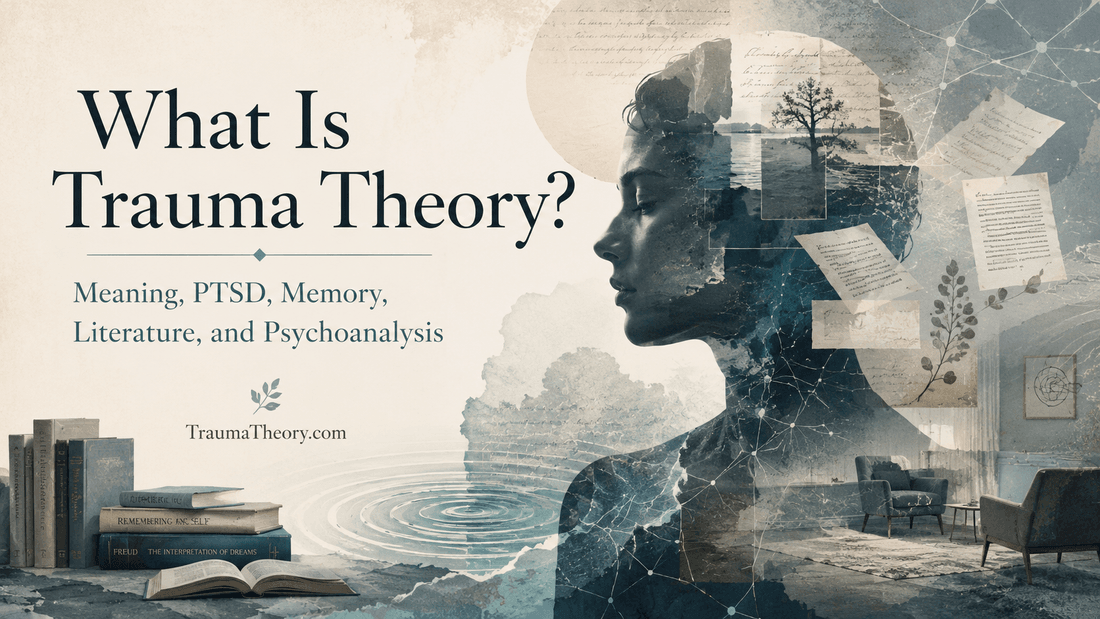
What Is Trauma Theory? Meaning, PTSD, Memory, Literature, and Psychoanalysis

What Is Trauma Theory

Trauma is one of the most used words of our time. People use it to describe war, abuse, loss, neglect, racism, illness, family pain, and many other forms of suffering. But trauma is not only about what happened. It is also about what the event does to a person’s mind, body, memory, relationships, and sense of meaning.

This is where trauma theory becomes important.

Trauma theory asks a simple but deep question: what happens when an experience is too painful, too frightening, or too overwhelming to be fully understood at the time?

The answer is not simple. Trauma can appear as fear. It can appear as numbness. It can return as memory, flashback, body tension, depression, or silence. It can also affect how people understand themselves, other people, and the world.

At TraumaTheory.com, trauma is explored through psychology, PTSD, literature, psychoanalysis, book reviews, and critical thought. This post explains trauma theory in clear language so that students, readers, survivors, and general visitors can understand the main ideas.

What Is Trauma Theory?

Trauma theory is a way of understanding how deeply painful experiences affect human beings.

It studies how trauma changes memory, identity, emotions, relationships, and meaning. It also asks how people remember trauma, speak about trauma, write about trauma, and try to live after trauma.

In simple terms, trauma theory looks at the gap between the event and the experience of the event.

Two people may go through similar events, but they may not experience those events in the same way. One person may feel fear and recover with support. Another person may carry the event for years through nightmares, flashbacks, numbness, shame, or a sense that the world is no longer safe.

Trauma theory helps us understand why this happens.

It does not reduce trauma to one symptom. It does not treat trauma only as a medical label. Instead, it studies trauma as something that affects the whole person.

Trauma Is More Than a Bad Memory

Many people think trauma is just a painful memory. But trauma often works differently from normal memory.

A normal memory usually feels like something that happened in the past. It may be sad or painful, but the person knows it is over.

A traumatic memory may not feel fully past. It may return with great force. It can feel as if the body and mind are still living inside the old danger.

This is why trauma can appear through:

  • Flashbacks
  • Nightmares
  • Sudden fear
  • Body tension
  • Emotional numbness
  • Avoidance
  • Shame
  • Irritability
  • Dissociation
  • Loss of trust
  • Loss of meaning

Trauma may also make a person feel divided. One part of the self may try to live normally. Another part may still feel trapped in terror, grief, or helplessness.

This is one reason why trauma theory often studies memory, dissociation, and repetition.

Trauma Theory and PTSD

PTSD stands for post-traumatic stress disorder. It is one of the most common ways modern society names serious trauma.

PTSD is often linked with war, assault, accidents, disaster, or other extreme events. But trauma can also come from long-term fear, neglect, abuse, humiliation, or loss.

The main symptoms of PTSD often include intrusion, avoidance, negative changes in mood, and changes in arousal. Intrusion means the trauma returns in unwanted ways. Avoidance means the person tries to stay away from reminders. Arousal can include feeling always on guard, easily startled, angry, or unable to rest.

One important question in trauma theory is whether PTSD should be understood mainly as a fear disorder, a memory disorder, a dissociative disorder, or something larger.

The post Are PTSD and C-PTSD dissociative disorders? Does it matter? explores this question in depth. It explains how PTSD and C-PTSD may involve dissociation, but also warns that dissociation is a defense against terror, not the whole story.

That distinction matters.

Trauma is not only the defense. Trauma is also the terror, helplessness, loss, and collapse of safety that made the defense necessary.

PTSD, C-PTSD, and Dissociation

PTSD and C-PTSD are related, but they are not always the same.

PTSD is often linked with a specific event or set of events. C-PTSD, or complex PTSD, is often linked with repeated or long-term trauma, especially when escape was difficult or impossible. This may include childhood abuse, neglect, captivity, domestic abuse, or long-term relational trauma.

C-PTSD may involve deeper changes in identity and relationships. A person may struggle with shame, trust, emotional regulation, and a steady sense of self.

Dissociation is one of the most important ideas here.

Dissociation means that parts of experience become separated. A person may feel detached from feelings, memories, body sensations, or even from the self. This can be frightening, but it can also be a survival response. When pain is too much to bear, the mind may create distance from it.

Trauma theory helps us understand dissociation not as weakness, but as a response to unbearable experience.

Trauma and Memory

Memory is central to trauma theory.

Trauma often creates a strange relationship with the past. The person may remember too much and too little at the same time.

Some parts of the event may be clear. Other parts may be missing, blurred, or difficult to place in time. A person may not have a complete story, yet the body may still react strongly to reminders.

This is why trauma is often described as memory that has not been fully integrated.

The traumatic past may return through:

  • Images
  • Sounds
  • Smells
  • Body pain
  • Panic
  • Dreams
  • Repeated actions
  • Sudden emotional states

The post PTSD and the death drive discusses the painful question of why trauma can repeat itself in memory, feeling, and bodily experience. The post shows how Freud’s ideas can still be useful when thinking about repetition and trauma.

Another related post, Peter Levine goes further than Bessel van der Kolk on the importance of body memory, looks at the idea that trauma may live not only in conscious memory, but also in the body.

This is an important point for trauma theory.

Trauma is not always remembered as a clear story. Sometimes it is remembered as a body state.

Trauma and Meaning

Trauma does not only hurt the mind. It can also damage meaning.

After trauma, the world may no longer feel safe, fair, stable, or worth trusting. A person may ask, “Why did this happen?” or “How can I live in a world where this is possible?”

These are not only medical questions. They are human questions.

Trauma can destroy the belief that life has order. It can make love, safety, trust, and hope feel fragile. It can make ordinary life seem unreal or unsafe.

The post Trauma destroys meaning explores this idea directly. It presents trauma as an attack on the meaning of existence, not only as a set of symptoms.

This is one of the most important lessons of trauma theory.

Healing is not only about reducing symptoms. It is also about rebuilding a relationship with life.

Trauma Theory and Literature

Trauma theory is widely used in literary studies. Scholars use it to read novels, poems, testimony, memoirs, and historical writing.

Literature can show how trauma breaks language. It can show silence, repetition, absence, fragmentation, and memory. It can also help readers understand the difficulty of telling a story about an experience that felt impossible to understand when it happened.

However, there is a danger.

Literary trauma theory should not be confused with real psychic trauma. A text can represent trauma, but a person lives trauma.

The post Literary theory is not trauma theory makes this distinction clear. It explains that trauma theory has become a major tool for reading literature, but also warns against confusing literary ideas with the suffering of real people.

This is important because trauma is not just a metaphor.

When trauma becomes only a literary symbol, the real pain of survivors can disappear. Good trauma theory should respect both literature and lived experience. It should help us read texts more deeply without losing sight of real human suffering.

Trauma, Testimony, and Story

Trauma often creates a problem of speech.

Some survivors need to tell their story. Others cannot tell it easily. Some tell it many times. Some feel that words are not enough.

This does not mean that trauma is always beyond language. It means that language may come slowly, painfully, or incompletely.

Testimony can be powerful because it gives shape to experience. It can help connect memory, feeling, and meaning. But testimony is not simple. Telling a trauma story can also reopen pain.

Trauma theory studies this tension.

It asks how people speak about trauma, how others listen, and what happens when society refuses to hear. It also asks whether testimony heals, whether it repeats the wound, or whether it does both at the same time.

Trauma and Psychoanalysis

Psychoanalysis has been connected with trauma from the beginning. Freud’s work often returned to memory, repetition, fear, loss, and the unconscious.

Modern psychoanalytic trauma theory looks at how trauma affects the self and relationships. It asks how trauma changes a person’s ability to trust, love, feel alive, and remain connected to others.

The post Trauma is the disruption of the ability to maintain relationships. Psychoanalysis can help. explains trauma as a loss of relationality. This means trauma can damage the ability to feel connected to oneself and to other people.

That idea is very useful.

Trauma often isolates. It can make people feel alone even when they are with others. It can make love feel dangerous. It can make ordinary closeness feel unsafe.

Psychoanalysis is helpful because it takes time, memory, desire, fear, fantasy, and relationships seriously. It does not treat the person as a list of symptoms. It listens for the deeper emotional life behind the symptoms.

This does not mean psychoanalysis is the only way to understand trauma. But it gives trauma theory a rich language for thinking about inner life.

Why Trauma Theory Matters Today

Trauma theory matters because trauma is everywhere in public life.

We hear about trauma in discussions of war, childhood abuse, sexual violence, racism, displacement, grief, illness, and political violence. We also see trauma used in schools, therapy, literature, history, social media, and everyday conversation.

This wide use can be helpful. It gives people language for suffering that was once ignored.

But it can also create confusion. If everything is trauma, the word can lose meaning. If trauma is used too loosely, it may become harder to understand severe psychic pain.

Good trauma theory helps keep the word meaningful.

It asks careful questions:

  • What makes an experience traumatic?
  • How does trauma affect memory?
  • Why does trauma repeat?
  • Why do some people feel numb?
  • How does trauma affect relationships?
  • Can trauma be represented in literature?
  • Can testimony help?
  • What kind of care does trauma require?
  • How can meaning be rebuilt?

These questions matter because trauma is not only a diagnosis. It is a way of understanding how human beings suffer, survive, remember, and try to live again.

Conclusion

Trauma theory helps us understand what happens when experience overwhelms the mind, body, memory, and sense of meaning.

It connects PTSD, C-PTSD, dissociation, memory, literature, testimony, psychoanalysis, and the search for healing. It shows that trauma is not only about the past. It is about how the past remains alive in the present.

At its best, trauma theory does not turn suffering into a slogan. It helps us think more carefully about pain, survival, memory, and care.

Trauma may break trust, language, relationships, and meaning. But understanding trauma is one way to begin putting these broken parts into words.

That is why trauma theory remains important. It helps us ask what trauma does, how it returns, how it is represented, and how people may begin to live beyond it.

Share