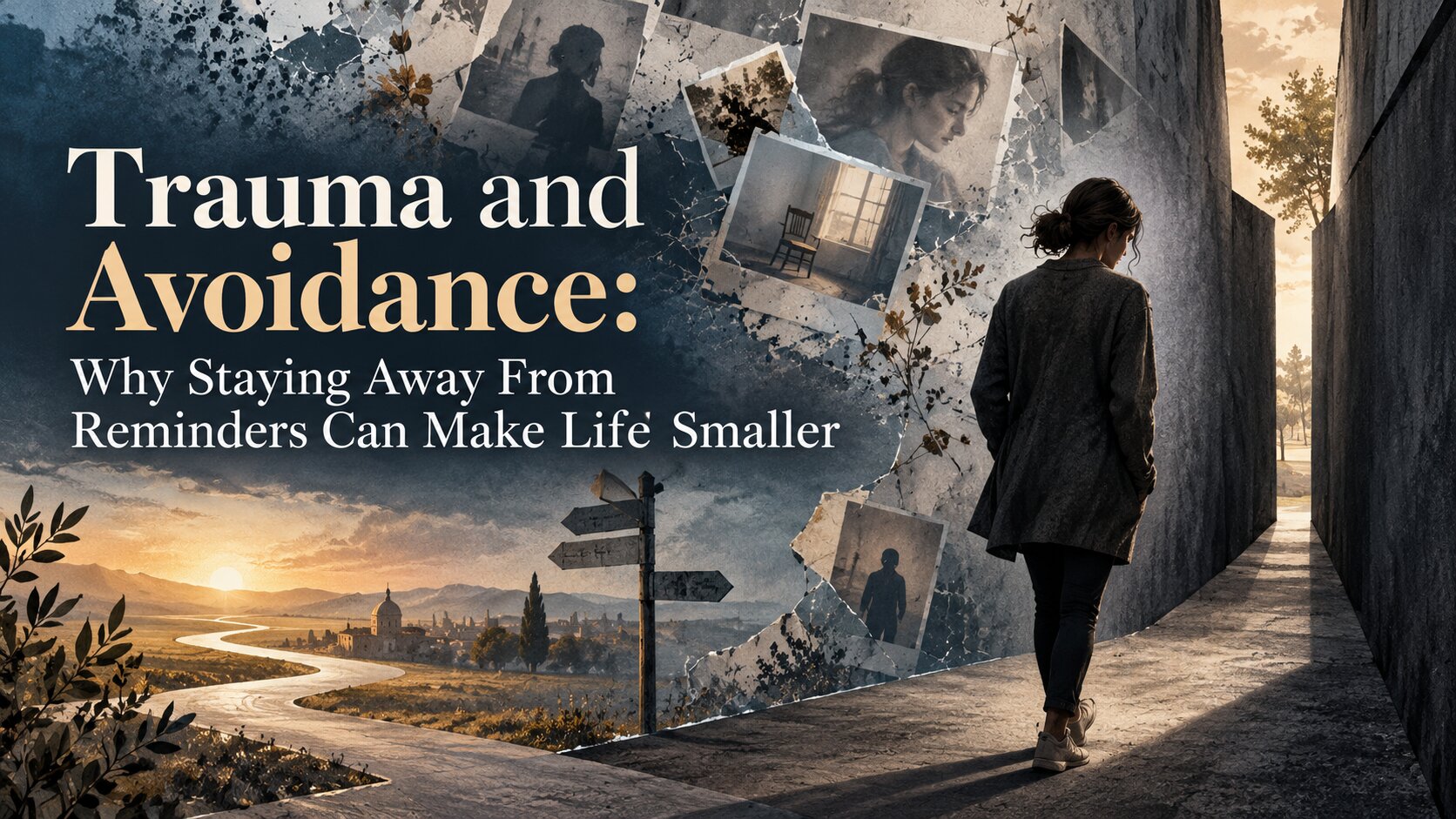
A person survives a serious car accident. Months later, the physical injuries have healed, but they no longer take the road where the crash happened. Soon they avoid highways altogether. Then they begin turning down invitations that require a long drive.
Each decision makes sense on its own. Avoiding the road brings relief. Staying home feels safer than facing the fear.
But something else is happening quietly. The person’s world is becoming smaller.
This is one way trauma and avoidance can become connected. Avoidance often begins as protection from distress. It can create distance from painful memories, uncomfortable feelings, frightening places, or situations associated with what happened.
That distance may feel helpful in the moment. When avoidance becomes the main way of coping, however, it can begin shaping daily life.
Understanding avoidance requires care. Staying away from something is not automatically unhealthy. Sometimes distance is wise. Sometimes privacy is necessary. Sometimes danger is still real.
The important question is not simply, “What is this person avoiding?”
It is, “What is avoidance doing in this person’s life?”
What Is Trauma Avoidance?
Trauma avoidance means trying to stay away from reminders of a frightening or overwhelming experience.
Those reminders can exist outside the person. Someone may avoid a particular street, building, activity, person, smell, sound, news story, or type of situation.
Avoidance can also happen internally. A person may try not to think about what happened. They may change the subject when certain memories arise or keep constantly busy so there is little time to reflect.
In PTSD, avoidance is important enough to form one of the main symptom groups. But experiencing avoidance does not automatically mean someone has PTSD. Diagnosis depends on a wider pattern of symptoms, their duration, and how they affect everyday functioning.
Our broader article on trauma theory and PTSD explains how PTSD can involve intrusive memories, fear, avoidance, changes in mood, and continued alertness after danger has passed.
This article focuses on one part of that larger picture: what happens when staying away becomes a central way of managing the past.
Avoidance Often Begins for a Good Reason
Avoidance is easy to criticize when we look at it from the outside.
Why not just go back?
Why not talk about it?
Why not stop thinking about what might happen?
These questions overlook the immediate value of avoidance.
Imagine that walking past a certain building produces intense fear. Taking another route removes that fear almost immediately. From the person’s point of view, the lesson is clear: avoiding the building worked.
The same can happen with conversations. If discussing an experience produces distress, changing the subject brings relief. If seeing someone brings back painful memories, avoiding that person may make the day easier.
The behavior is not irrational in the simple sense.
It solves an immediate problem.
The difficulty is that short-term relief and long-term freedom are not always the same thing.
The Short-Term Relief of Avoidance
Avoidance can create a powerful cycle because relief arrives quickly.
A reminder appears. Distress rises. The person moves away from the reminder. Distress falls.
That reduction in discomfort can make avoidance more likely the next time.
Consider someone who becomes frightened in crowded stores after a traumatic event. They leave the store and immediately feel calmer. On the next shopping trip, they may hesitate before entering. Eventually, ordering everything online may feel easier.
Again, none of these choices is automatically a problem.
The difficulty appears when the person no longer has a meaningful choice. They are not choosing between two reasonable options. Fear is making the decision for them.
Avoidance then begins to organize life.
How Avoidance Can Make Life Smaller
Trauma-related avoidance rarely needs to change everything at once.
It can happen gradually.
A person stops visiting one place. Then another place feels too similar. They avoid one conversation. Later, they avoid people who might begin that conversation. They turn down one social event and discover that staying home prevents uncomfortable reminders.
Over time, the map of acceptable places and experiences may shrink.
A person who once travelled freely may stay close to home. Someone who enjoyed concerts may stop attending crowded events. A person who valued relationships may reduce contact because emotional closeness brings uncomfortable memories.
The person may feel safer.
But safety gained through avoiding more and more of life can come at a high price.
Work, friendship, recreation, intimacy, and independence may gradually become restricted.
This is why trauma avoidance cannot be understood only by asking whether it reduces fear.
We also have to ask what it costs.
External Avoidance: Staying Away From Reminders
External avoidance involves things in the environment.
A person may avoid locations connected with trauma. They may stay away from particular people, activities, objects, sounds, smells, dates, media reports, or situations.
After a serious collision, someone may avoid driving. After an assault, a person may avoid the area where it happened. Someone who experienced violence in a crowd may become uncomfortable in packed public spaces.
These connections can be obvious.
Others may be surprisingly specific.
A particular perfume may bring back a memory. A song may become associated with a painful period. A certain time of day may create discomfort because an important event happened then.
The reminder itself is not dangerous in the present. But it has acquired meaning through the past.
Our article Trauma and Memory: Why the Past Can Feel Present explores this problem in greater depth. Trauma reminders matter because memory does not always remain quietly in the past. A present experience can suddenly carry the emotional weight of something much older.
Avoidance tries to prevent that collision between past and present.
Internal Avoidance: Trying Not to Think or Feel
Not all avoidance can be seen.
A person may continue going to work, seeing friends, and completing ordinary responsibilities while avoiding important parts of their inner experience.
They may refuse to think about what happened. They may push away sadness whenever it appears. They may immediately distract themselves when a memory begins.
Some people stay extremely busy.
Work, television, exercise, social activity, gaming, scrolling, or endless tasks can sometimes create enough mental noise to keep painful thoughts away.
The activity itself may be healthy. The important question is its function.
Is someone exercising because they enjoy exercise, or because being still feels unbearable?
Are they working long hours because the work matters, or because going home leaves too much space for memory?
The same action can have very different psychological meanings.
This is why avoidance is not always obvious from behavior alone.
Avoidance Is Not the Same as Forgetting
A person who avoids trauma reminders has not necessarily forgotten what happened.
Often the opposite is true.
The memory may matter so much that the person organizes life around preventing it from becoming active.
They may avoid the street because they remember. They may avoid the conversation because they know what feelings it could bring. They may avoid a relationship because closeness has become connected with danger.
Avoidance can therefore show the continuing importance of the memory.
The person is trying to keep the past at a manageable distance.
This is different from ordinary forgetting.
Something that has truly become unimportant does not usually require constant effort to avoid.
Avoidance and Hypervigilance Can Work Together
Avoidance and hypervigilance may look different, but they can support one another.
Hypervigilance says, “Watch carefully so danger does not surprise you.”
Avoidance says, “Stay away so danger cannot reach you.”
One response increases attention. The other reduces contact.
Both can develop around the same need for protection.
For example, someone may avoid crowded places because crowds feel unsafe. When they cannot avoid one, they may become intensely watchful of exits, movements, and unfamiliar people.
Our article on trauma and hypervigilance examines what happens when attention remains organized around possible threat.
Avoidance offers another strategy.
Instead of watching the dangerous-looking world more carefully, it reduces how much of that world the person enters.
Avoidance and Dissociation Are Not the Same
Avoidance and dissociation can also appear similar from the outside.
A person may seem distant, silent, or unwilling to discuss what happened.
But the psychological processes can differ.
Avoidance generally involves moving away from a reminder, thought, feeling, or situation. Dissociation involves some degree of disconnection from experience, such as feeling emotionally numb, unreal, separated from the body, or cut off from memory.
The same person may experience both.
They may deliberately avoid certain conversations and then dissociate when an unexpected reminder appears.
The article PTSD and Dissociation: Why Trauma Can Make the Mind Feel Divided explores how trauma can create this sense of distance from memory, feeling, or self.
Keeping the concepts separate matters because not every silence is avoidance, and not every emotional distance is dissociation.
Trauma theory becomes more useful when it preserves these differences.
Emotional Avoidance Can Affect Relationships
Relationships naturally involve emotion.
People disagree. They become disappointed. They feel vulnerable. They depend on one another. They risk rejection and loss.
For someone whose trauma involved another person, these ordinary parts of relationships may become especially difficult.
A person might avoid discussing problems because conflict feels dangerous. They may leave when emotions become intense. They may keep relationships superficial because closeness creates vulnerability.
From the outside, this may appear uncaring.
Inside, the logic may be different.
Closeness has become associated with risk.
Avoidance can then protect against painful emotions while also making intimacy harder to maintain.
A relationship cannot become very close if important feelings must always remain outside it.
This creates another paradox of avoidance: the strategy used to prevent pain may also prevent experiences that could become meaningful.
Avoidance Is Not the Same as a Healthy Boundary
This distinction is especially important.
A boundary is not automatically avoidance.
Someone may choose not to see an abusive family member. That can be protection rather than pathological avoidance.
A survivor may decide that they do not want to discuss certain details publicly. That is not necessarily fear. It may be privacy.
Someone may decline an event because they genuinely dislike it, not because trauma is controlling the decision.
Trauma language should not be used to remove people’s right to make choices about their own lives.
A useful question is whether the decision expands or protects a person’s ability to live according to their values, or whether fear is steadily removing options they would otherwise want.
The distinction will not always be simple.
But it is better than assuming every decision to stay away represents a symptom.
Privacy Is Not Avoidance
People who have experienced trauma do not owe their stories to other people.
They do not have to describe what happened to friends, coworkers, relatives, or strangers in order to prove that they are healing.
Choosing not to discuss an experience can be a legitimate decision.
This connects with our discussion of trauma and testimony, which asks what happens when painful experiences are spoken and how responsibility also belongs to the listener.
There is a significant difference between saying, “I choose not to tell you,” and feeling, “I cannot allow myself to think about this at all.”
One involves control over personal information.
The other may involve fear of internal experience.
The difference matters.
Trauma theory should make room for both speech and silence without treating either one as automatically healthy or unhealthy.
When Avoidance Protects Someone From Real Danger
Another distinction is even more important.
Sometimes the danger has not ended.
A person experiencing ongoing abuse may avoid the person harming them. Someone being stalked may change routines. A person living in a violent environment may avoid certain locations because the threat is genuine.
These are not situations where someone simply needs to overcome an irrational fear.
Real danger requires real protection.
Trauma discussions sometimes begin from the assumption that the frightening event is safely in the past. That assumption can be wrong.
Before describing behavior as excessive avoidance, we need to ask whether the situation the person is avoiding remains dangerous.
Psychological explanations should never replace ordinary attention to reality.
Avoidance and the Loss of Choice
One useful way to think about avoidance is through choice.
Imagine two people who both decide not to attend a large concert.
The first person simply prefers quieter activities. They could attend if they wanted to but see no reason to go.
The second person loves live music and deeply wants to attend. But every time they imagine entering the crowd, fear becomes overwhelming.
The outward behavior is identical.
The meaning is different.
This is why the goal should not be forcing people to perform particular activities. The more important issue is whether fear has taken control of choices the person wishes they could make.
Avoidance becomes especially significant when someone repeatedly says:
“I want to, but I can’t.”
That sentence reveals the conflict between desire and protection.
Why “Just Face Your Fear” Is Too Simple
Once avoidance is recognized, people may move to the opposite extreme.
“If avoidance is bad, just face everything.”
That advice can also be unhelpful.
Trauma is not a test of courage.
Forcing someone into an overwhelming situation without preparation, choice, or appropriate support can increase distress rather than reduce it.
The problem with avoidance is not that people should never step away from difficult experiences. Everyone needs limits.
The deeper goal is greater flexibility.
Can the person decide when to approach and when to step back?
Can they tolerate some reminders without becoming overwhelmed?
Can they gradually return to things that matter to them?
A life completely controlled by avoidance is restrictive.
A life in which someone is forced to confront every painful reminder would be equally unlivable.
The important word is choice.
Avoidance Can Hide Inside Ordinary Habits
Not all trauma avoidance looks dramatic.
Sometimes it becomes part of routine.
A person may take a longer route every morning without thinking much about why. They may always keep conversations light. They may immediately turn off movies containing certain themes.
After years, these habits can feel like personality.
“I just don’t like driving.”
“I am not an emotional person.”
“I hate crowds.”
Sometimes these statements are simply true.
But occasionally, an ordinary preference may have a history.
The person may have forgotten when the habit began or why it became necessary.
Understanding that history does not mean every habit needs to change.
It can simply restore awareness.
A choice is different when a person understands what they are choosing and why.
Avoidance and the Meaning of Safety
Avoidance often promises safety.
Stay away from the place.
Do not discuss the memory.
Do not trust too quickly.
Do not take the risk.
These strategies may reduce distress, but they can also change what safety means.
Instead of safety meaning “I can handle ordinary life,” it may begin to mean “nothing difficult must happen.”
That standard is impossible to maintain.
Life contains uncertainty, uncomfortable emotions, disagreement, and loss even without trauma.
The article Trauma and Meaning: Why Life Can Feel Different After Trauma explores how traumatic experience can alter beliefs about safety, trust, identity, and the future.
Avoidance can become part of that changed meaning.
The world starts to feel safe only when enough of it has been removed.
Avoidance Can Affect Identity
People often describe themselves through what they do.
“I travel.”
“I love meeting people.”
“I play music.”
“I enjoy hiking.”
“I am independent.”
Trauma-related avoidance can interfere with these ordinary parts of identity.
Someone who once loved travelling may stop. A social person may become isolated. A musician may avoid performing because a stage has become connected with a painful experience.
The loss is therefore not only behavioral.
The person may begin asking, “What happened to the person I used to be?”
This question can be painful because avoidance may protect against one kind of suffering while producing another: the loss of activities, relationships, and identities that once mattered.
Trauma does not only create fear of the past.
It can restrict possibilities for the future.
When Avoidance Becomes Isolation
Social withdrawal deserves special attention.
People may avoid others because conversation feels exhausting, because they do not want questions, because crowded spaces feel unsafe, or because they believe nobody will understand.
Temporary solitude can be restorative.
Long-term isolation can become different.
Friendships weaken when invitations are repeatedly declined. Family members may stop asking. Activities once shared with others disappear.
The person’s world may then contain fewer sources of support precisely when support would be valuable.
This does not mean people should be pushed into social situations they do not want.
It means we should notice when avoidance creates a second problem.
The original goal was to reduce distress.
The result may eventually include loneliness.
Can Avoidance Keep Trauma Reminders Powerful?
Avoidance prevents contact with reminders.
That can also prevent opportunities to discover that the reminder and the original danger are not always the same thing.
Consider someone who was injured in a car accident and completely stops driving.
They know intellectually that every road is not dangerous. But because they no longer drive, they have fewer experiences of travelling safely.
The frightening expectation remains largely untested.
The avoided situation can therefore preserve its power.
This helps explain why avoidance may feel safer while making fear harder to revise.
The VA’s National Center for PTSD distinguishes between avoiding external reminders, such as places and people, and avoiding internal experiences, such as thoughts and feelings. It also notes that relying heavily on avoidance can interfere with recovery.
That does not mean every reminder should be confronted immediately.
It means avoidance has consequences worth understanding.
Trauma Avoidance Does Not Always Look Like Fear
Sometimes the emotion underneath avoidance is not obvious fear.
It may be shame.
A person avoids old friends because they do not want questions.
It may be guilt.
Someone avoids speaking about an event because remembering raises painful thoughts about what they did or did not do.
It may be grief.
A person avoids photographs because they bring back someone who died.
It may be anger.
Someone refuses to visit a place associated with betrayal.
The behavior is similar—staying away—but the emotional meaning differs.
This is another reason broad labels can mislead.
Understanding avoidance requires asking what becomes difficult when the reminder appears.
Avoidance, Memory, and the Return of the Past
Trauma creates an unusual tension.
A person may desperately want the past to stop intruding while organizing daily life around preventing its return.
The avoided memory remains important precisely because so much effort is spent keeping it away.
This is one reason trauma theory has long been interested in repetition, memory, and defenses.
What appears absent may still influence behavior.
A person does not have to talk constantly about the past for the past to remain active.
Sometimes its presence is visible through everything that must be avoided.
That gives avoidance a strange structure.
The trauma may not appear directly.
Instead, we see the empty spaces around it.
Does Avoidance Always Need Treatment?
No single behavior determines whether someone needs professional help.
Many reactions after frightening experiences lessen over time. People also differ greatly in how they cope.
Professional support may be worth considering when distress remains intense, persists over time, or begins significantly interfering with work, relationships, sleep, transportation, education, or other important parts of daily life.
Treatment decisions should be individualized.
The important point for this article is simpler: avoidance is not automatically weakness, and confronting reminders is not automatically healing.
What matters is the larger pattern and whether the person has enough freedom to live the life they want.
From Avoidance Toward Flexibility
The opposite of avoidance is not recklessness.
It is flexibility.
A flexible person can recognize genuine danger and step away from it. They can also recognize when fear belongs more to an earlier experience than to the present situation.
They can choose privacy without being unable to think.
They can decide not to visit a place without believing that every similar place must also be avoided.
They can feel discomfort without automatically reorganizing life to eliminate it.
This kind of flexibility allows safety and freedom to exist together.
The goal is not to become fearless.
Fear is useful.
The goal is for fear to become information rather than the only authority making decisions.
What Trauma Theory Still Needs to Ask About Avoidance
Avoidance raises questions that deserve more attention.
One concerns digital life. It is now possible to avoid people without leaving home, block entire subjects, filter news, mute words, and construct highly controlled online environments. When does this create healthy boundaries, and when does it make avoidance easier to maintain?
Another concerns social life. Some people are encouraged to “cut off” anyone associated with discomfort. Sometimes distance is necessary, particularly in harmful relationships. But how should trauma theory distinguish protective boundaries from a growing inability to tolerate ordinary conflict?
A third question concerns institutions. Schools, workplaces, and healthcare systems increasingly use trauma-informed language. Should they always remove distressing situations, or can avoiding every source of discomfort sometimes limit participation and growth?
These questions do not have simple answers.
They also show why trauma and avoidance deserve a discussion beyond a symptom checklist.
Readers who have thoughts about the difference between healthy boundaries and trauma avoidance are welcome to contribute them in the comments. A thoughtful question may help open a useful direction for future posts.
Conclusion
Avoidance often begins with a reasonable purpose.
Something hurts, frightens, overwhelms, or reminds a person of what happened. Moving away brings relief.
That relief is real.
But the long-term effect can be more complicated.
One avoided place can become several. One difficult conversation can become a subject that is never mentioned. One decision to stay home can gradually become a life organized around preventing distress.
This is why trauma and avoidance need to be understood together.
Avoidance is not simply cowardice, weakness, or refusal to recover. It can be an intelligent protective response that has continued beyond the conditions that originally made it necessary.
At the same time, protection can become restriction.
The important distinction is not between people who avoid and people who courageously confront everything.
It is between having choices and gradually losing them.
Recovery does not require ignoring danger or abandoning sensible boundaries. It may involve developing enough flexibility to recognize that a reminder is not always the original event, discomfort is not always danger, and the present does not always have to follow the rules created by the past.
Trauma can redraw the map of a person’s life around places they should not go, feelings they should not experience, and memories they should not touch.
Healing may begin when that map slowly becomes larger again.


